IRR Calculator

Calculate IRR (internal rate of return) online

$

Cash Flow (negative or positive)

Period 1
$
Period 2
$
Period 3
$
Period 4
$
Period 5
$
%
Quick answer

The internal rate of return (IRR) is the annual growth rate an investment is expected to generate — precisely, the discount rate that makes the net present value of every cash flow equal zero. Enter your initial investment and the cash flow for each period in the calculator above to get your IRR instantly. A project is worth pursuing when its IRR exceeds your hurdle rate.

What is IRR

IRR explained

IRR stands for internal rate of return.The IRR is the interest rate (also known as the discount rate) that makes the NPV (Net Present Value) of all cash flows (both positive and negative) from a project or investment equal to zero. For instance, the investment's IRR is 25%, which is the rate that makes the net present value of the investment's cash flows equal to zero. It's an important financial metric often applied to analyse the desirability of a potential investment or a project. The higher IRR of an undertaken project indicates more worth pursuing and expected to give good return in future. IRR is sometimes also called as ERR or economic rate of return.

IRR Calculation Formula

IRR or internal rate of return is calculated in terms of NPV or net present value. So, the formula for calculating IRR is same as NPV. Where NPV value is equal to zero.

IRR Formula

Where in the above formula :

N = total number of periods

n = positive integer

C = cash flow

r = internal rate of return

NPV = net present value

Read more: IRR Formula

How to Calculate IRR with example

Suppose a company plans to invest in a project with initial investment amount of $10000. The expected net cash flow for three years are to be $4500,$4000 and $5500 repectively. Let's calculate the internal rate of return for these period.

So the formula would be :

0 = C1/(1+r) + C2/(1+r)2 + C3/(1+r)3 - initial investment

After putting value in above equation, here's how the IRR equation looks:

0 = 4500/(1+r) + 4000/(1+r)2 + 5500/(1+r)3 - 10000

In this case, the r is 0.182, which makes IRR as 18.2%

Let's suppose the company is getting 10% return in other investment, then in the financial standpoint, the company must pursue this project which is likely to yield higher return of 18.2%.

Read more: Calculation of IRR in Excel

IRR decision criterion

The general IRR decision rule is, if IRR of a project is greater than the company's minimum acceptable rate of return then the project should be taken. But if the IRR falls below the minimum acceptable rate of return then the project should be dropped. When comparing different projects, IRR can help us determine the project's likelihood of profit in future. A project with higher IRR should be given more weightage than project with lower IRR.

IRR uses

IRR is used to evaluate desirability of a project or investment. Assuming all project require same up-front investment then the one with higher IRR is considered as desirable.

IRR plays good role in stock buyback programs inside big corporations. It shows if the investment in company's own stock is better than any other outside investment or use of the capital.

Limitations of IRR

IRR should not be used to decide the mutually exclusive projects but to decide if a single project is worth pursuing.

Other limitation of IRR is that all cash flows are assumed to be re-invested at same rate but in real world this may change over long term.

IRR shouldn't be used to compare projects of different durations. A project of shorter duration may have higher IRR than the project of longer duration.

About IRR Calculator

Calculating IRR (internal rate of return) can sometimes become too complex. You can use special financial calculators (like,Ti-83,Ti-84 and HP 12c calculator) or programs like Excel. IRR Calculator is one such free online tool to calculate the internal rate of return of an investment. To calculate IRR just fill in the initial investment amount followed by the net cash flow (negative or positive) in each period and then click on calculate button to get the IRR result .

How to calculate IRR using this calculator

If you are using this calculator for the first time then you might need to understand that how this calculator works for calulating IRR or internal rate of return.

In the given calculator above, if your cash flow number(i.e, period) is more than 5 times then you can add more period by simply hitting the "Add Period" button and if it's lesser then 5 times then you can delete the number of period by clicking on "Delete Period" button.

Here's an example of cash-flow statement provided in table below which can be used for inputing the value in the given calculator above. Let the initial investment be $10000. The initial investment can be called as "Period 0" investment.

Cash-flow Table
Period Amount
Initial Investment(Period 0) $10000
Period 1 $2000
Period 2 $1000
period 3 $1500
period 4 $-500
period 5 $-400
period 6 $300

The above information in the table can be used to enter the value in the calcualtor input field. As it has total 7 number of cash flows including initial investment. So, use the "Add button" to add extra cash flow field.

Here' the example picture of calculator field. To get the value of IRR, simply click calculate button which will take you to the next page showing the result.
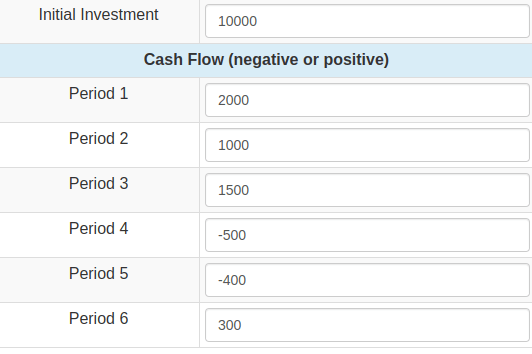
IRR example with calculator

What is a good IRR?

A good IRR is any IRR that comfortably beats your hurdle rate — the minimum return you demand for taking on the risk. There is no universal threshold, and any article that gives you one is simplifying. A 9% IRR is excellent for a regulated utility funded with 5% debt, and disappointing for an early-stage venture fund whose portfolio is expected to lose money on most investments.

Two projects with identical IRRs can also carry wildly different risk. Judge an IRR against three things: the cost of the capital funding it, the risk you are accepting, and the returns available elsewhere for that same risk.

Investment type Target IRR commonly cited Why
Government bonds 3% – 5% Near risk-free, so the return is close to the cost of money itself
Infrastructure & utilities 6% – 10% Predictable, regulated cash flows over long horizons
Public equity (broad market) 8% – 12% Roughly the long-run return of a diversified stock index
Commercial real estate 12% – 20% Leverage and illiquidity demand a premium over bonds
Private equity buyouts 18% – 25% Compensates for leverage, illiquidity and a long lock-up
Early-stage venture capital 25% – 40%+ Most investments fail, so the winners must carry the whole fund

These are conventional target ranges used across the industry, not promises or predictions. Treat them as a sanity check: if a proposal claims a 45% IRR on a low-risk asset, the assumptions behind the cash flows deserve far more scrutiny than the IRR itself.

Beware one trap in particular. IRR is annualised, so a very short project can post a spectacular IRR while creating almost no value. Turning $1,000 into $1,100 in one month is a 213% IRR and a $100 gain. Always read IRR alongside NPV, which tells you the size of the prize.

IRR vs NPV, ROI, CAGR and XIRR

IRR is one of a family of return metrics, and choosing the wrong one is the most common mistake in investment analysis. The difference comes down to a single question: does the metric care about when the money moves?

Metric What it tells you Accounts for timing? Use it when
IRR The annual rate of return, as a percentage Yes, but assumes equal periods Cash flows arrive at regular intervals
NPV Value created, as a currency amount Yes Ranking mutually exclusive projects
ROI Total gain as a percentage of cost No Quick, rough comparison over one fixed period
CAGR Smoothed annual growth between two values Only start and end dates One amount in, one amount out, no interim flows
XIRR The annual rate of return, as a percentage Yes, using exact dates Cash flows arrive on irregular dates

IRR vs NPV

NPV answers “how much richer will this make me?” and IRR answers “what rate does this earn?” They are two views of the same discounting maths: IRR is simply the discount rate at which NPV crosses zero. Where they disagree — typically when projects differ in size or in duration — trust NPV. A 60% IRR on a $10,000 project creates less wealth than a 20% IRR on a $10 million one. For a fuller side-by-side treatment, see NPV vs IRR.

IRR vs ROI

ROI ignores time completely. Doubling your money in one year and doubling it in ten years are both a 100% ROI, yet the IRRs are 100% and roughly 7.2% — a difference that decides whether the investment was brilliant or mediocre.

IRR vs CAGR

CAGR needs only a starting value and an ending value, so it cannot handle money added or withdrawn along the way. IRR can. Use CAGR for a single lump sum left untouched; use IRR the moment interim cash flows appear. We cover this in depth in CAGR vs IRR.

IRR vs XIRR

IRR assumes every period is the same length. Real investments rarely cooperate: a SIP instalment on the 3rd of one month and the 7th of the next, a dividend in between, a partial withdrawal in December. XIRR uses the exact date of each cash flow and is the more accurate choice whenever the intervals are uneven. If your dates are irregular, use our XIRR calculator instead.

When IRR breaks down: multiple IRRs and no IRR

IRR is the root of a polynomial, and polynomials do not always behave. This is the limitation most calculators quietly ignore, and it can invalidate a decision entirely.

A project can have more than one IRR

By Descartes' rule of signs, a cash-flow series can have as many internal rates of return as it has changes of sign. Consider a mine that costs money to open, earns money while producing, then costs money again to restore the land:

-1,000  →  +2,500  →  -1,560

The signs flip twice, and this series has two mathematically valid IRRs: 20% and 30%. Both make the NPV exactly zero. Neither is more correct than the other, and no calculator can tell you which one to act on — including this one, which reports 20%. When the sign changes more than once, IRR stops being a meaningful answer. Fall back on NPV at your actual cost of capital, or use the modified internal rate of return (MIRR), which forces a single solution by discounting outflows and compounding inflows at rates you specify.

A project can have no IRR at all

IRR exists only when the cash flows change direction at least once. If you never get money back, no rate of return can be computed — there is nothing to solve for. Some sign-changing series have no real solution either: -1,000, +2,500, -2,000 never crosses zero for any real discount rate.

In both cases this calculator shows an error rather than a plausible-looking number. A wrong IRR is far more dangerous than a missing one.

IRR, hurdle rate and WACC

An IRR means nothing on its own. It becomes a decision only when you compare it with the cost of the money funding the project.

The rule is simple: accept the project when IRR > hurdle rate, reject it when IRR < hurdle rate. A project earning 12% funded with capital costing 9% creates value. The same 12% funded with capital costing 15% destroys it, even though 12% sounds healthy in isolation.

When IRR sits close to the hurdle rate, the decision rests on assumptions inside your cash-flow forecast rather than on the IRR itself. Test what happens to the result when your revenue estimate falls 10%.

Monthly, quarterly and annual IRR

The IRR this calculator returns is per period, whatever period your cash flows use. Enter monthly cash flows and you get a monthly IRR. To convert it to an annual figure you must compound it, not multiply it:

Annual IRR = (1 + r)n − 1

where r is the IRR per period and n is the number of periods in a year (12 for monthly, 4 for quarterly).

Suppose you invest $10,000 and receive $900 at the end of each of the next 12 months. The calculator returns a monthly IRR of 1.2043%. The annual equivalent is:

(1 + 0.012043)12 − 1 = 15.45%

Not 14.45%, which is what multiplying by 12 would have given you. The gap is compounding, and it widens with the rate. If your periods are not evenly spaced in the first place, no annualisation will fix that — use the XIRR calculator, which works directly from dates.

Frequently Asked Questions

What is a good IRR?

A good IRR is one that comfortably exceeds your hurdle rate — typically your cost of capital plus a margin for risk. There is no universal number: 9% may be excellent for low-risk infrastructure and poor for venture capital, where funds often target 25% or more.

What is the difference between IRR and NPV?

NPV tells you how much value a project creates, as a currency amount. IRR tells you the discount rate at which that NPV becomes zero, as a percentage. When ranking projects that you cannot do all of, NPV is the more reliable measure.

What is the difference between IRR and ROI?

ROI measures total gain as a percentage of the amount invested and ignores time. IRR is annualised and accounts for when each cash flow arrives. Doubling your money in one year and in ten years are both a 100% ROI but roughly a 100% and a 7.2% IRR.

Can IRR be negative?

Yes. A negative IRR means the project returns less capital than went into it, so the investment destroys value. An IRR of −10% means the money shrank at about 10% a year.

Can a project have more than one IRR?

Yes. A cash-flow series can have as many IRRs as it has changes of sign. The series −1,000, +2,500, −1,560 has two valid IRRs, 20% and 30%, and both make the NPV zero. When cash flows change direction more than once, use NPV or MIRR instead.

Why does my IRR calculation return an error?

IRR only exists when the cash flows change sign at least once. If nothing ever comes back, there is no rate to solve for. A few sign-changing series, such as −1,000, +2,500, −2,000, have no real solution either. In those cases the calculator reports an error rather than a misleading number.

How do I convert a monthly IRR into an annual IRR?

Compound it rather than multiplying: annual IRR = (1 + r)12 − 1. A monthly IRR of 1.2043% annualises to 15.45%, not 14.45%.

Should I use IRR or XIRR?

Use IRR when cash flows fall at regular, equally spaced intervals. Use XIRR when they fall on irregular dates, which covers most real investments including SIPs, top-ups and staggered withdrawals.

What is the reinvestment assumption in IRR?

The IRR formula implicitly assumes every interim cash flow is reinvested at the IRR itself. A 40% IRR assumes you can keep reinvesting proceeds at 40%, which is rarely realistic. This is why a high IRR can overstate the return you will actually earn, and why MIRR often gives a more honest figure.

Is this IRR calculator free?

Yes. It is completely free, needs no sign-up and runs in any browser. Enter the initial investment and each period's net cash flow, then click Calculate IRR.

How this calculator works

Accuracy matters more than speed in financial tools, so it is worth being explicit about the method. This calculator solves for the rate r that makes the net present value of your cash flows equal zero, using the same numerical root-finding approach as the IRR function in Microsoft Excel and Google Sheets. For identical inputs it returns identical results.

Reviewed for methodology and formula accuracy against Excel's IRR function. Last updated: .

Written by

Ambuj

Personal Finance & Value Investing Enthusiast

Ambuj has spent over 15 years studying personal finance and value investing, and builds free financial tools used by thousands of people worldwide to make better-informed money decisions. He writes and maintains every calculator and article on this site.

You might like Our Other Financial Calculators

Free online tools from our finance calculator network


Disclaimer: The IRR Calculator provides "IRR" or "internal rate of return" without any warranty for it's accuracy. Any reliance by you on any information or advice will be at your own risk. Every decisions should be made after consultation with your financial advisor or professional.This website is not responsible for, and expressly disclaims all liability for, damages of any kind arising out of use, reference to, or reliance on any information contained within the site. By using this website you agree to those terms, if not then do not use this website.